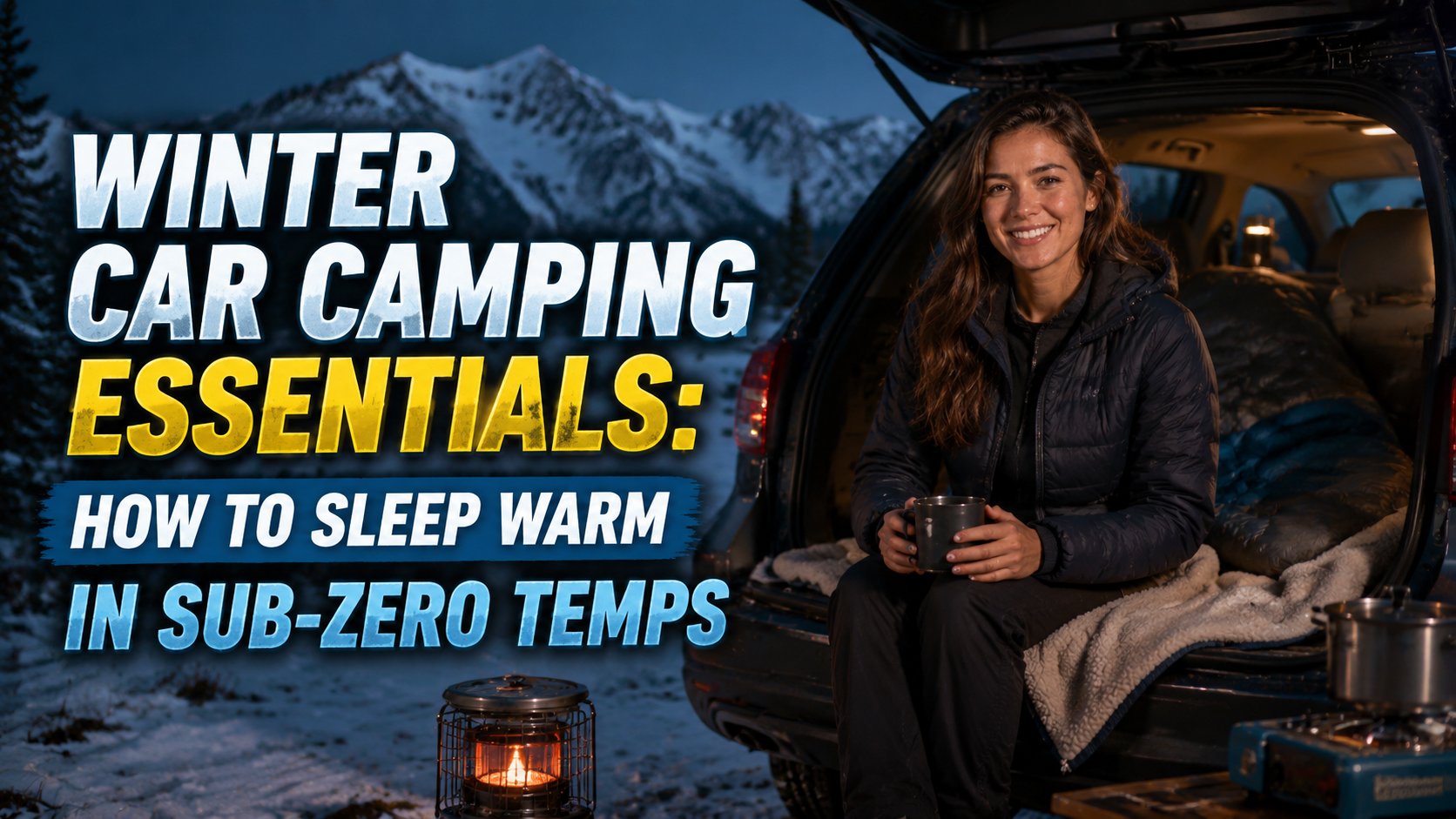
❄️ TL;DR — Quick Verdict
Sub-zero car camping is safe and comfortable with the right system — and dangerous without it. The combination of vehicle as wind block plus a properly built sleep system handles -10°F nights without engine heat.
The safety rule that matters most: Never run your engine all night for heat. Carbon monoxide buildup from a snow-blocked exhaust pipe is the #1 cause of car-camping deaths. Build a passive warm system instead, and use a CO detector as backup.
The minimum sleep system for sub-zero: -20°F EN/ISO bag + R-6.0+ sleeping pad + window insulation + cross-ventilation. Details below.
Winter car camping below 0°F is its own category — different from tent backpacking in winter, and different from summer car camping that happens to get cold. The vehicle changes the math in two big ways: it gives you a wind block and thermal mass that ambient temperature alone doesn’t capture, and it introduces a different set of failure modes (carbon monoxide poisoning, condensation, blocked exhaust) that don’t exist in tent camping.
This guide walks through the sleep system, vehicle setup, safety rules, and the cold-weather habits that turn a sub-zero night from survival into actually-good sleep.
A note on honesty: this is a research-based guide built from REI Expert Advice, mountaineering safety curricula, vehicle camping forums, and outdoor gear manufacturer documentation. It is not a hands-on field test. Where we cite numbers, we cite the source.
Safety First: 3 Things That Can Kill You
Skip this section at your own risk. The risks in sub-zero car camping are different from regular cold-weather camping, and the most dangerous one is invisible.
☠️ Risk #1: Carbon monoxide poisoning.
The #1 cause of car-camping fatalities. Never run your engine all night for heat. Even with a “clear” tailpipe at bedtime, snow can drift in by morning and block the exhaust, causing CO to back up into the cabin while you sleep. CO is colorless, odorless, and you don’t wake up.
Safe practice: build a passive sleep system warm enough that no engine heat is needed, and install a battery-powered CO detector in the cabin as a backup. Run the engine only briefly (10–15 minutes every few hours) for top-up warmth during the evening, with at least one window cracked.
🥶 Risk #2: Hypothermia from a wet sleep system.
Sub-zero air dries gear out — but only if the gear can vent. A sealed vehicle traps your exhaled moisture, soaks down insulation, and turns a -20°F bag into a 20°F bag overnight. Use synthetic insulation if you can’t manage humidity; use cross-ventilation if you’re using down.
🦶 Risk #3: Frostbite from exposed extremities.
Below 0°F with wind, exposed skin can freeze in under 30 minutes. The danger zones: nose, ears, fingers, toes. Keep extremities covered when you’re outside the vehicle, and never sleep with bare feet sticking out of the bag.
The 4 Vehicle Setup Options
Where exactly you sleep changes the gear you need. The four common setups, ranked from coldest to warmest:
| Setup | Insulation | Setup time | Cost | Best for |
|---|---|---|---|---|
| Ground tent next to vehicle | Coldest — wind exposure | 15–30 min | Lowest | Larger groups, established sites |
| Truck bed (open or topper) | Cold — single-wall metal | 5 min | Truck owners | Solo or duo, frequent winter camping |
| SUV/wagon cargo area | Warmer — fully enclosed | 0 min | Free | Most beginners, single night |
| Rooftop tent | Warmer than ground tent — off snow | 5 min | $1,500–$4,000+ | Frequent winter trips, comfort priority |
🚗 The most accessible option for beginners is the SUV cargo setup. Fold the rear seats flat, lay down a sleeping pad, and sleep in the enclosed space. The vehicle blocks wind, retains thermal mass from the day, and lets you store gear up front. This is what we’ll assume for the rest of this guide; truck bed and rooftop tent setups follow the same principles with adjustments for exposure.
The Sleep System for Sub-Zero
Three components, all of which need to match the conditions. Skip any one and the other two are wasted.
Sleeping Bag: -20°F EN/ISO or Colder
For sub-zero camping you need a bag with an EN/ISO Comfort rating at or below your expected overnight low — which usually means a Lower Limit of -20°F or below for true sub-zero conditions. Remember that the EN/ISO Lower Limit is a survival rating, not a comfort rating. The Comfort rating is typically 10°F warmer.
| Bag labeled | EN/ISO Lower Limit | Realistic comfortable sleep |
|---|---|---|
| 0°F bag | 0°F | Comfortable to ~15°F — not enough for sub-zero |
| -20°F bag | -20°F | Comfortable to ~-10°F — minimum for sub-zero |
| -40°F bag | -40°F | Comfortable to ~-25°F — for serious winter trips |
Down vs synthetic at sub-zero: Down wins on warmth-to-weight and packed size — important if you’re transitioning between car and ground travel. Synthetic wins on moisture resistance — important inside a sealed vehicle where condensation is the limiting factor. For dry-cold environments (interior Rockies, eastern Sierra winter), down is the better default. For wet-cold or vehicle-camping with ventilation challenges, synthetic earns its keep.
🔗 Deep dive: For the full down-vs-synthetic decision and how to read EN/ISO labels, see Down vs Synthetic Sleeping Bags and Cold Weather Sleeping Bags 0–20°F.
Sleeping Pad: R-6.0+ (or Stack Two)
Cold ground inside a vehicle is still cold ground. Vehicle metal floors are even worse — they conduct heat away faster than dirt or snow. Your pad must handle this.
Minimum R-value for sub-zero car camping: R-6.0, ideally R-7.0+. Achieving this either with a single high-R-value pad or by stacking two pads (R-values are additive):
| Approach | Combined R-value | Pros | Cons |
|---|---|---|---|
| Single premium insulated air pad | R 6.0–7.0+ | Lightest, most comfortable | Can puncture; expensive |
| Closed-cell foam (R 2.0) + insulated air pad (R 4.5) | R 6.5 | Bulletproof — foam can’t fail; redundant | Bulkier (fine for car) |
| Self-inflating pad (R 4.0) + foam pad (R 2.0) | R 6.0 | Cheapest combination | Heaviest stack |
🔗 Deep dive: Sleeping Pad R-Value Guide — the spec that decides whether your bag actually works.
Liner + Sleeping Clothes: The Free 10°F
A thermal sleeping bag liner adds 10–15°F of effective warmth for $30–$50. A silk liner adds 5–10°F. Combined with dry base layers, a beanie, and dry wool socks, this stack can take a -20°F bag down to effectively -30°F performance for one night.
The clothing rules for sleeping in sub-zero:
- Merino or synthetic base layer top and bottom (never cotton)
- Dry wool socks (not the ones you wore during the day)
- Beanie or balaclava — at least 25% of body heat escapes through the head
- NEVER sweat into your sleep clothes. Change into them in the evening, before activity stops generating heat. If you sleep in sweat-damp clothes, you’ll wake up cold and the down loses loft.
🎯 Want this matched to your specific trip and forecast?
Tell us your destination, dates, and expected low temperatures — we’ll generate your full winter car camping gear list, with sleep system rated for actual sub-zero conditions and budget options.
→ Generate My Checklist · Free · No signup · Vetted Amazon & REI picks
Vehicle Insulation: The $30 Upgrade That Matters Most
The largest cold surfaces in your vehicle are the windows. Even with the engine off, your body heat will continuously bleed out through uninsulated glass for the entire night. The fix is cheap and dramatic.
Reflectix bubble insulation is the standard solution. A single $30 roll from Home Depot or Lowe’s covers two medium SUVs with leftover material. Method:
- Press Reflectix against each window from the inside.
- Trace the outline with a permanent marker, leaving about 1/2” extra on all sides.
- Cut with scissors. The slight oversize creates friction-fit retention.
- Install with the silver side facing inward for cold weather (reflects body heat back into the cabin). The black side faces outward.
- Store flat or rolled between trips.
🛒 The cost-benefit math: A full Reflectix set ($25–$30) raises interior overnight temperature by an estimated 5–10°F vs uninsulated glass. That’s equivalent to upgrading from a 0°F bag to a -10°F bag (which costs $100–$200 more). Best ROI of any winter car-camping upgrade.
Other vehicle insulation considerations:
- Door panel gaps can leak warm air; small foam blocks or weatherstripping at the door seams helps.
- Sunroof is a major heat-loss point if not covered — make a Reflectix insert for this too.
- Floor insulation between your sleeping pad and metal floor: a closed-cell foam pad serves double duty here.
- Front seat barrier: a folded blanket draped between the cargo area and front seats reduces convective heat loss to the cooler front of the vehicle.
Heat Generation & Retention (Without Running the Engine)
Once the sleep system and vehicle insulation are sorted, these techniques add another 5–10°F of effective warmth.
💧 Hot water bottle in the sleeping bag. Fill a hard-sided Nalgene with near-boiling water before bed, wrap in a sock, and place inside your bag at your core (chest or feet). Provides 2–3 hours of active heat as you fall asleep. Free, takes 5 minutes, works every night.
🧤 Chemical hand warmers. 10-hour disposable warmers ($1 each) placed inside sleeping clothes or your sleeping bag near feet and core. Cheap and effective for one-night trips. They generate heat through controlled oxidation of iron filings — no flame, no CO risk.
🔋 Batteries inside the sleeping bag. Phones, headlamps, GPS units, power banks — cold drains batteries fast. Tuck them inside your sleeping bag overnight so they’re full and working in the morning. A drained phone is a safety problem if you need to call for help.
🥜 Fatty snack before bed. Digesting fat is exothermic — your body generates heat for 2–4 hours after eating. Counter-intuitive for backpacking weight rules, but a great cold-weather sleep aid. Examples: a small handful of nuts, a tablespoon of peanut butter, a piece of cheese.
🚽 Empty your bladder before bed. Holding warm urine costs calories your body needs for heat generation. Pee 15 minutes before getting into the bag, even if you don’t feel a strong urge.
Condensation Management: The Hidden Problem
A sleeping human exhales roughly 1 liter of moisture per 8 hours. In a sealed vehicle, that moisture has nowhere to go except onto your cold windows, metal surfaces, and sleeping bag. Wake up to a soaked bag and you’ve solved one problem (warmth at night) by creating another (cold gear in the morning).
The counterintuitive fix: crack the windows even when it’s freezing.
🪟 Cross-ventilation method:
Crack two windows on opposite sides of the vehicle, each by 1/4” to 1/2”. This creates passive airflow that vents your exhaled moisture without creating a wind tunnel.
Heat loss is minimal — well under 1°F over a full night. Moisture savings are dramatic — the difference between waking up to dry gear vs damp gear.
Additional moisture management:
- DampRid or silica gel packets placed in the cabin absorb residual moisture overnight.
- Small microfiber towel for wiping down windows in the morning before getting up.
- Don’t cook inside the vehicle. A single pot of pasta produces several cups of water vapor on top of what you exhale.
- Don’t dry wet gear overnight inside the vehicle. Hang wet socks/jackets in front seats with windows cracked, or outside the vehicle if temperatures and animals allow.
Cooking in Sub-Zero
Standard isobutane canister stoves struggle below 20°F because fuel pressure drops too low to vaporize properly. For sub-zero cooking you have two practical options:
Option A: Liquid fuel stove. White-gas stoves (MSR WhisperLite International, Optimus Polaris) work reliably down to -40°F. They require pre-heating (“priming”) with a small amount of fuel, but they cook hot meals in any winter conditions. Best for serious or frequent winter campers.
Option B: Warm-and-use canister method. Keep your isobutane canister inside your sleeping bag overnight and inside your jacket during the day. Just before cooking, hold it in your hands for 60 seconds to warm it. Works down to about 10°F; performance drops sharply below that.
⚠️ Cooking safety in sub-zero car camping:
Cook outside the vehicle, always. Inside-the-vehicle cooking creates carbon monoxide from any flame-based stove and adds dangerous amounts of moisture to the air. The exception: a self-enclosed butane stove in a vestibule with full ventilation, and even then only briefly.
🎒 Want the gear list done for you?
Plug in your trip and conditions. We’ll generate a complete winter car camping checklist with the sleep system, vehicle prep, safety gear, and cooking equipment sized for sub-zero — all vetted from Amazon and REI.
→ Build My Personalized List · Takes 30 seconds
Eating, Hydration, and Cold-Weather Metabolism
Your body burns roughly 30–40% more calories at sub-zero temperatures than at room temperature, just to maintain core temperature. You’ll be hungrier than expected and dehydrated faster than expected.
- Eat 3,500–4,500 calories per day at sub-zero (vs 2,500 indoors). Lean toward fats and proteins — they burn slower and longer than carbs.
- Drink 3+ liters per day. Cold air is dry, breathing rate is high, and you’ll lose fluids fast even without sweating. Insulate water bottles to prevent freezing — sleep with them in your bag, store them upside down (water freezes from the top down, so the cap stays usable longer), or use vacuum-insulated bottles.
- Hot drinks throughout the evening = active calorie absorption + morale. Tea, hot chocolate, broth.
What to Look For When You Shop
If you’re building a winter car camping kit from scratch, here’s how to allocate your budget across the system. Don’t over-invest in one item while skimping on others.
💰 Budget allocation for a starter sub-zero car camping kit ($800–$1,200 total):
Sleeping bag (-20°F): $300–$500 · Sleeping pads (stacked): $150–$250 · Reflectix + window covers: $30–$50 · Liner + sleeping clothes: $80–$120 · CO detector: $30–$50 · Liquid fuel stove (optional): $100–$170 · Vehicle organizing (totes, mats): $100–$150
The single biggest upgrade is the sleeping bag. A $250 0°F bag is genuinely inadequate for sub-zero; a $400 -20°F bag handles the conditions properly. Don’t try to fix an under-rated bag with extra layers — at sub-zero, you need real warmth at the source.
What’s worth spending more on:
- Sleeping bag (your single biggest comfort + safety variable)
- Sleeping pad (R-value is non-negotiable at sub-zero)
- CO detector (a $30 item that prevents a fatal outcome)
What’s NOT worth spending more on for a first kit:
- Liquid fuel stove (canister + warming hack works for moderate winter trips)
- Custom Reflectix shapes (a roll + scissors is just as effective as pre-cut sets)
- Camp blankets / down throws (your sleeping bag is doing this job)
5 Mistakes Beginners Make at Sub-Zero
- Running the engine all night for heat. The single most dangerous mistake. Snow drifts can block your exhaust within hours, causing CO buildup that kills silently. Build a passive system warm enough to skip the engine entirely.
- Trusting a bag’s temperature rating without checking EN/ISO Lower Limit. A “0°F” bag without an EN/ISO designation might mean Lower Limit (survival rating, ~15°F actual comfort) or might mean something else entirely. At sub-zero, the gap kills.
- Skipping window insulation. Uninsulated windows leak more body heat than any other surface in the vehicle. $30 of Reflectix is the highest-ROI upgrade for the cost.
- Sealing the vehicle completely. Counterintuitive but critical: cross-ventilation through two cracked windows is mandatory for moisture control. A sealed vehicle leaves you sleeping in your own exhaled humidity.
- Inadequate pad R-value. A premium sleeping bag on an R-3 summer pad still sleeps cold at sub-zero. Stack pads if you don’t have a single high-R-value option. R-6.0 minimum, R-7.0+ preferred.
Frequently Asked Questions
Is it safe to sleep in your car in sub-zero temperatures?
Yes, with proper gear and safety precautions. The two most serious risks are carbon monoxide poisoning (if you run the engine for heat with a blocked tailpipe) and hypothermia (if your sleep system is inadequate). Most experienced winter campers consider temperatures down to -10°F safely manageable with proper gear; below -30°F outside air temperature is widely considered the upper limit for non-expedition car camping.
Can I run my car’s heater all night to stay warm?
No — this is the #1 cause of car-camping fatalities. In snow, your exhaust pipe can become blocked, causing carbon monoxide to back up into the cabin and kill you while you sleep. Even with a clear tailpipe, running the engine all night wastes fuel and risks battery drain. The safe approach is a proper cold-weather sleeping system that requires no engine heat, plus a carbon monoxide detector as a backup.
What sleeping bag rating do I need for sub-zero car camping?
For sub-zero temperatures (below 0°F), look for a bag with an EN/ISO Comfort rating at or below the expected lows — meaning a Lower Limit of -20°F or colder. Remember that the EN/ISO Lower Limit is a survival rating, not a comfort rating; the Comfort rating is typically 10°F warmer. Pair the bag with a sleeping pad rated R-6.0 or higher, and consider stacking a closed-cell foam pad under an insulated air pad for redundancy.
Should I insulate my car windows for winter camping?
Yes — window insulation is one of the highest-return upgrades for winter car camping. Reflectix bubble insulation cut to fit your windows costs under $30 for an entire SUV and dramatically reduces heat loss through the largest cold surfaces in your vehicle. With the silver side facing inward, it reflects your body heat back into the cabin and prevents condensation buildup on the inside of the glass.
How do I prevent condensation when sleeping in my car?
A sleeping person exhales roughly 1 liter of moisture per 8 hours. In a sealed vehicle, that moisture condenses on every cold surface. The fix is counterintuitive but essential: crack two windows on opposite sides of the vehicle for cross-ventilation, even when it’s freezing outside. Add a small moisture absorber (DampRid or similar) and keep a microfiber towel handy for wiping down windows in the morning.
Will canister stoves work in sub-zero temperatures?
Standard isobutane canister stoves struggle below 20°F because the fuel pressure drops too low to vaporize properly. For sub-zero cooking, switch to a liquid fuel stove (white gas) like an MSR WhisperLite, which works reliably in any temperature. As a workaround, you can keep canister stoves inside your sleeping bag overnight and warm them in your hands before lighting, but performance still suffers below 10°F.
What’s the difference between car camping in winter and tent camping in winter?
Three big differences. First, your vehicle acts as a wind block and thermal mass, making the interior several degrees warmer than ambient air. Second, you can carry heavier and bulkier gear — thick mattresses, propane heaters, multi-night food supplies — because you don’t carry it on your back. Third, the failure modes are different: tent camping risks hypothermia from gear failure; car camping risks carbon monoxide poisoning from improper heating.
Verdict — Our Sub-Zero Car Camping System
If you remember nothing else from this guide:
❄️ The minimum viable system for sub-zero car camping:
- Sleeping bag: EN/ISO Lower Limit at or below -20°F (Comfort ~-10°F)
- Sleeping pad: R-6.0+ (stack pads if needed)
- Vehicle insulation: Reflectix-cut window covers, silver side inward
- Ventilation: Two windows cracked 1/4”–1/2”, opposite sides
- Safety: Battery-powered CO detector in the cabin
- Heat aids: Liner, dry sleep clothes, hot water bottle, hand warmers
Never run your engine all night for heat. Build the passive system above instead.
For the gear-specific deep dives this article references:
- Down vs Synthetic Sleeping Bags — fill choice for cold and damp conditions
- Cold Weather Sleeping Bag Guide 0–20°F — EN/ISO ratings and construction features
- Sleeping Pad R-Value Guide — the spec that matters as much as the bag
- What to Pack for a 3-Day Camping Trip — the Ten Essentials baseline
❄️ Ready for winter? Let us build the kit.
Plug in your destination, dates, vehicle type, and expected lows. We’ll generate a complete sub-zero car camping checklist — sleep system, vehicle prep, safety gear, cooking equipment, and clothing — sized for your trip and budget. All vetted from Amazon and REI.
→ Generate My Camping Checklist · Free · No signup · Built for first-time winter campers
Sources referenced: REI Expert Advice: Winter Camping Checklist · How to Insulate a Car for Winter Camping · The Manual: Winter Car Camping Guide · Bearfoot Theory: 21 Cold Weather Camping Tips · Adventure Journal: Reflectix Solution · CDC: Carbon Monoxide Poisoning FAQ
Disclosure: TrailPackList earns commissions through the Amazon Services LLC Associates Program and the REI affiliate program when readers click through and purchase. We do not accept payment for placement in our checklist generator.
Planning your trip?
Use our free checklist generator to build a personalized gear list in seconds.
Build my checklist →