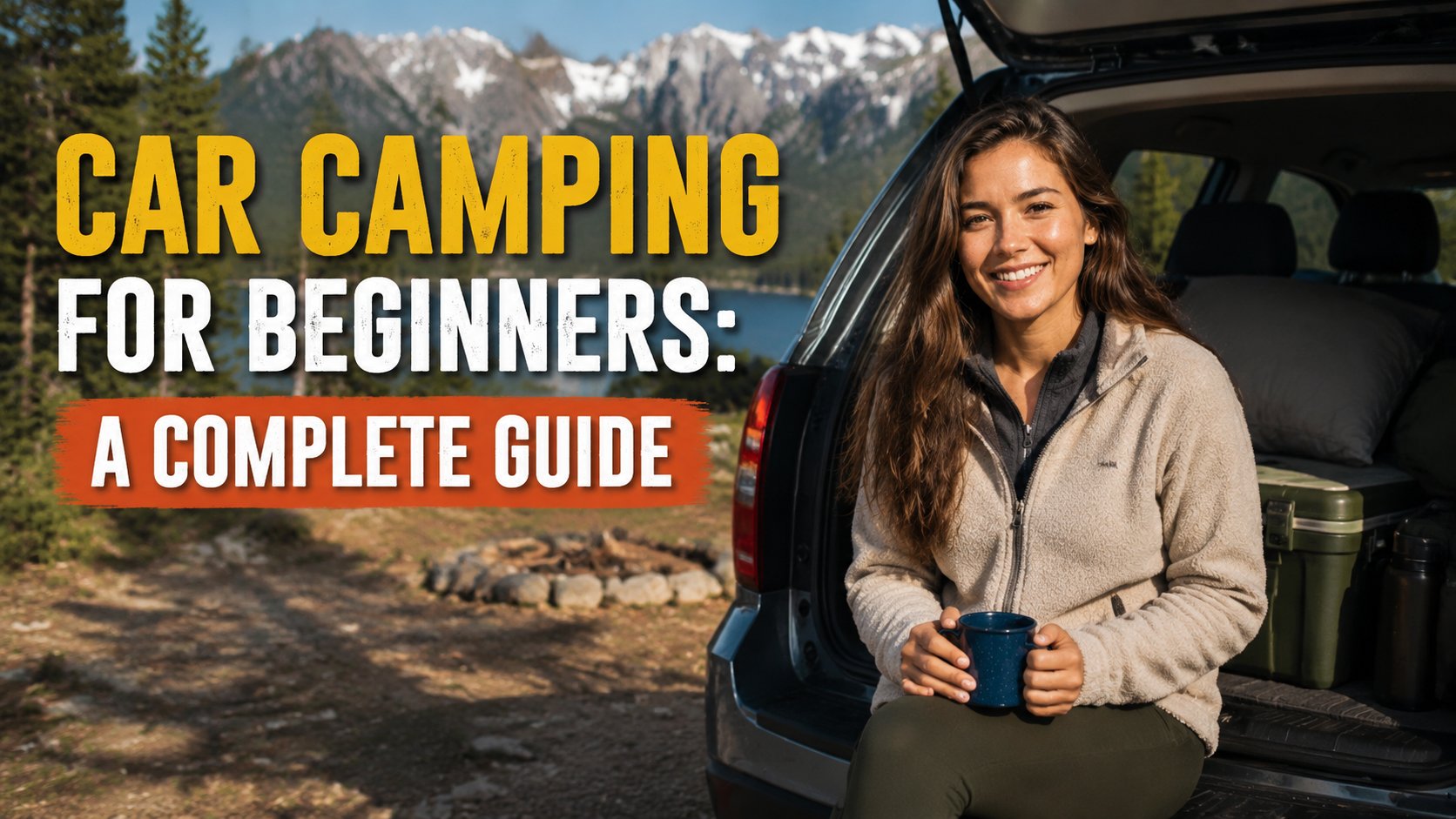
🏕️ TL;DR — Quick Verdict
Car camping is the easiest entry point into outdoor recreation. You drive to your site, sleep near your car, and bring whatever heavy comfortable gear you want without carrying it more than a few feet.
For your first trip: book a developed campground 4–8 weeks ahead, within 90 minutes of home, for one night. Bring the 5 essential gear systems (shelter, sleep, kitchen, light/power, safety). Expect $400–$600 for a starter kit if buying everything new.
This is a pillar guide — broad overview with links to deep dives for each sub-topic.
Car camping is how nearly everyone starts outdoor recreation. It’s also how most people stay outdoor campers their whole lives — backpacking and ultralight thru-hiking get the attention online, but the actual majority of camping in the US is families and friends driving to a campground for a weekend.
This guide covers the entire car camping basics: types of campsites, how to find and book them, the gear systems you need, the first-time-camper routine, and where to go deeper on each topic. The depth comes from linked guides on each sub-topic.
A note on honesty: this is a research-based pillar guide built from REI Expert Advice, Bearfoot Theory, KOA campground resources, and US Forest Service / National Park Service public information. It is not a hands-on field test. Where we cite numbers, we cite the source.
Car Camping vs Backpacking: Which Are You Doing?
The two are different sports, and the gear is different. Knowing which you’re doing on day one saves you from buying the wrong things.
| Car camping | Backpacking | |
|---|---|---|
| Distance from vehicle | At or near (within 100 ft) | 1–20+ miles |
| Gear weight matters | No — bring whatever | Critical — every ounce counts |
| Pack required | Just car space | 50–70 L backpacking pack |
| Comfort gear | Chairs, big cooler, lantern OK | Strictly essentials |
| Tent size | 4–6 person family tent | 1–2 person ultralight |
| Cooking | 2-burner stove, real cookware | Tiny canister stove, 1 pot |
| Food storage | Cooler with fresh food | Dehydrated, no fresh |
| Trip length | 1 night to indefinite | 1–7+ nights typically |
| Best for | Families, beginners, weekenders | Solo/duo, fitness-oriented, remote experiences |
If this is your first trip, start with car camping. Backpacking adds significant complexity (weight management, navigation, water filtration in the field, food planning by weight). Backpacking will be there in year 2 or 3 if you want it.
The 4 Types of Campsites
Where you camp determines everything else — cost, amenities, scenery, crowds, and what gear you need.
1. Developed Campgrounds (Best for Beginners)
These are the standard campgrounds in state parks, national parks, and many private operators. They have facilities and clear rules.
🏕️ What you get at a developed campground:
- Designated campsite with picnic table, fire ring, often a tent pad
- Restrooms (often flush toilets, sometimes showers)
- Potable water from spigots
- Trash and recycling service
- Campground host on-site
- Usually 30–200 sites total — neighbors but not crowds
- Costs: $20–$40/night in state parks, $25–$45 in national parks, $35–$70 at private operators
This is the right starting point for first-time campers. The infrastructure removes the unknowns.
2. Private Campgrounds & Hipcamp
KOA, Jellystone, and similar chains run private campgrounds with more amenities (often pools, wifi, laundry) but a less “wilderness” feel. Hipcamp is essentially Airbnb for camping — private landowners listing sites on their property.
🏠 Best for: Families with young children (more amenities for kids), people who want some convenience features, RV-friendly camping. Often more booking flexibility than national/state parks.
3. Dispersed Camping (Free, No Amenities)
US Forest Service and BLM land allows free camping on most undeveloped areas, called dispersed camping. You drive down forest service roads, find a previously-used pullout, and set up. No fees, no reservations, no facilities.
🌲 What dispersed camping is:
- Free — no fees or reservations required
- No services — no water, no toilets, no trash, no fire rings
- No designated sites — find a previously-used pullout to minimize impact
- Pack everything out — including human waste in some areas
- 200-foot rule — camp at least 200 feet from any water source
Best for: experienced campers who want solitude and aren’t paying for facilities they wouldn’t use. Not recommended for your first car camping trip — too many variables.
4. Primitive / Minimally Developed Sites
A middle ground: designated sites with fire rings and pit toilets, but no running water or showers. Often in state or national forests where developed campgrounds don’t exist. Modest fees ($5–$15/night) or free with permit.
🎯 First-trip recommendation: developed campground within 90 minutes of home.
Pick one night. Don’t push for 3 nights on a first trip. Things will go wrong — gear will be missing, you’ll have packed wrong, you’ll forget how the tent works. A 1-hour drive home is better than a 4-hour drive home with a tired family.
How to Find and Book a Campsite
The reservation system is the single most confusing part of camping for beginners. Different sites use different platforms, and the popular ones fill up months ahead.
Federal Lands (National Parks, National Forests, BLM)
Recreation.gov handles reservations for nearly all federal campgrounds.
- National Parks campgrounds: book 6 months in advance to the day, opening at 10 a.m. ET. Popular sites (Yosemite Valley, Yellowstone, Grand Canyon South Rim) fill within minutes.
- National Forest campgrounds: more availability, often bookable 6 months out but with later openings into the booking window.
- Dispersed camping in National Forests: no reservation needed; some specific areas require free permits.
State Park Campgrounds
Each state runs its own system. Some examples:
- California State Parks: ReserveCalifornia.com, 6 months ahead
- Texas State Parks: TexasStateParks.org, 5 months ahead
- New York State Parks: NewYorkStateParks.reserveamerica.com, 9 months ahead
Check your specific state’s parks website for the exact platform.
Private Campgrounds and Hipcamp
- KOA: koa.com — usually bookable 1+ year ahead
- Hipcamp: hipcamp.com — variable, often 1–4 weeks ahead with private landowner availability
- Direct booking: smaller private campgrounds often have their own websites or phone reservations
Reservation Timing Strategy
| When you’re booking | What’s available |
|---|---|
| 6+ months ahead | Premier National Park sites |
| 3–6 months ahead | Most state park premium sites, popular weekends |
| 1–3 months ahead | Most state park standard sites |
| 2–4 weeks ahead | Hipcamp, private campgrounds, mid-tier state parks |
| Last minute | Dispersed camping, walk-ups at quieter sites |
🎯 Want help picking gear and a site that match?
Tell us your trip type and dates — we’ll generate your full gear list, sized for your camping style and budget.
→ Generate My Checklist · Free · No signup · Vetted Amazon & REI picks
The 5 Essential Gear Systems
Car camping gear divides into 5 systems. Get each one functional, in any quality tier, and you have a complete kit.
System 1: Shelter (Tent, Footprint, Stakes)
A tent for car camping can be larger and heavier than what backpackers carry because you’re not hiking with it. The standard rule: buy a tent rated for one more person than your group. Solo? Buy a 2-person tent. Duo? Buy a 4-person tent. The extra space lets you store gear inside out of weather.
Key specs:
- Hydrostatic head: 1,500mm minimum for fair weather, 3,000mm+ for rainy climates
- Full-coverage rainfly (extends to ground, not just over the top)
- Dome or cabin design — easy to pitch
- Vestibule for wet gear storage outside the tent interior
For wet-climate camping, see our Camping in the Rain: 15 Essentials. For tent moisture problems beginners often face, see Tent Condensation: How to Prevent and Fix It. For beach or sandy terrain, see How to Choose Tent Stakes for Sandy Beach Camping.
System 2: Sleep (Bag, Pad, Pillow, Optional Cot)
This is the system that decides whether you sleep well or wake up cold and tired. Don’t cheap out here.
Sleeping bag: for car camping in 3-season conditions, a 20°F EN/ISO Comfort rated bag handles most trips. For colder trips, see Cold Weather Sleeping Bags 0–20°F. The down-vs-synthetic decision is covered in detail in Down vs Synthetic Sleeping Bags.
Sleeping pad: the spec that matters here is R-value. For 3-season car camping, R-value 3.5–4.5 is the sweet spot. The full breakdown is in our Sleeping Pad R-Value Guide. For car camping specifically, you can also use a thick foam mattress topper or air mattress — comfort over weight when you don’t have to carry it.
Pillow: A camping pillow ($15–$30) or a stuff sack with a fleece jacket inside.
Optional cot: A camping cot ($60–$150) gets you off the ground, adds insulation, and is dramatically more comfortable than sleeping on the floor. Worth the investment for repeat campers.
Bonus warmth upgrade: For winter or cold-weather extensions of your 3-season bag, see How to Make Your Sleeping Bag Warmer with a Liner.
System 3: Kitchen (Stove, Fuel, Cookware, Cooler, Food)
Car camping kitchens are dramatically more capable than backpacking kitchens — you can cook real meals.
Stove: a 2-burner propane stove (Coleman Classic, Camp Chef Everest) handles everything car campers need. $60–$130 for solid options. Single-burner backpacking stoves work too but limit you to one cooking task at a time.
Fuel: standard 1-lb propane canisters; bring 2 per weekend.
Cookware: a 10-inch pan, a medium pot (3–4 qt), a cutting board, real plates and utensils, and a basic spice kit.
Cooler: a hard-sided cooler with ice keeps food safe for 2–4 days. A premium cooler (Yeti, RTIC, Coleman Xtreme) keeps ice longer if you’re going more than 2 nights. Budget option: $40 Coleman; premium: $250+ Yeti.
Food storage: dry foods in plastic bins, perishables in the cooler, snacks in a daypack for hikes.
System 4: Light and Power
Once it gets dark at a campsite, it’s dark. You need light.
Headlamp: one per person. IPX4+ rating for weather resistance. $20–$50.
Lantern: one per group, lights up the picnic table and tent interior. LED rechargeable lanterns ($30–$80) are easier than propane lanterns.
Power bank: 10,000–20,000 mAh keeps phones charged for a weekend. $30–$80.
Optional: a portable power station (Jackery, EcoFlow) for multi-day trips or running fans, lights, or small electronics. $200–$500.
System 5: Safety (The Ten Essentials)
Same system used by backpackers — adapted for car camping. The Ten Essentials are non-negotiable.
🆘 Ten Essentials for car camping:
- Navigation (paper map of the area + phone GPS)
- Sun protection (sunglasses, sunscreen, hat)
- Insulation (warm layer beyond what you’ll wear)
- Illumination (headlamp + spare batteries)
- First-aid kit
- Fire (lighter + waterproof matches)
- Repair kit & knife
- Extra food (one day beyond planned)
- Extra water (gallon+ per person per day, plus reserve)
- Emergency shelter (space blanket — even in your tent setup)
The full system is covered in What to Pack for a 3-Day Camping Trip.
The First-Timer’s Setup Routine
The first time you set up camp will take 2–3× as long as you expect. Plan for it.
🗓️ The arrival-to-bedtime timeline:
Hour 1 (arrival): Check in with campground host or self-register. Drive to your site. Walk around it before unloading anything — note where the sun goes down, where the wind comes from, where the level ground is, where the picnic table is.
Hour 2 (shelter): Pitch the tent in the most sheltered, level spot. Stake it out. Pitch the rainfly. Place a footprint or tarp inside if needed. Set up the sleep system inside.
Hour 3 (kitchen): Set up the stove on the picnic table or a stable surface (never on the table directly if it’s wood — heat damage). Organize the cooler nearby. Lay out cookware.
Hour 4–5 (camp + dinner): Set up chairs, lantern, fire (if permitted). Start dinner. Eat. Clean up before dark.
Pre-bed: Brush teeth, change into sleep clothes, all food in cooler or bear-proof storage (this matters even in non-bear country — raccoons exist), trash secured, vehicle locked.
Sleep.
The next morning, breakfast and break camp takes about 2 hours for a first-time camper. By day 2, it’ll be 1 hour.
🎒 Want the whole car camping kit done for you?
Plug in your trip details — destination, length, group size, conditions. We’ll generate the complete checklist across all 5 systems. All vetted from Amazon and REI.
→ Build My Personalized List · Takes 30 seconds
Food Planning for Car Camping
Car camping food can be dramatically better than backpacking food because you have a cooler and a real stove. Plan accordingly.
Breakfast ideas:
- Eggs and bacon (eggs in a sealed container, bacon pre-cooked at home)
- Pancakes with mix from home + fresh fruit
- Yogurt and granola for low-prep mornings
Lunch ideas:
- Sandwiches with deli meat and cheese (kept cold in the cooler)
- Hummus, pita, cut vegetables
- Trail mix and energy bars for hike days
Dinner ideas:
- One-pot pasta with sauce and veggies
- Foil-pack meals (chicken, potatoes, butter, herbs, wrapped in foil and cooked over coals)
- Tacos (pre-cook the meat at home, reheat at camp)
- Hot dogs / sausages (simple but classic)
Don’t bring:
- Anything you can’t keep cold for the trip length
- Glass containers (break easily)
- Foods that require complex prep (you won’t want to deal with it)
The 7 Leave No Trace Principles
Whether you’re at a developed campground or dispersed in the forest, these are the standards:
- Plan ahead and prepare. Know the rules of where you’re going.
- Travel and camp on durable surfaces. Stay on established sites and trails.
- Dispose of waste properly. Pack out all trash, including food scraps. Use established toilets or bury human waste 6–8 inches deep, 200 feet from water.
- Leave what you find. Don’t pick plants, collect rocks, or move historical artifacts.
- Minimize campfire impacts. Use existing fire rings, keep fires small, ensure dead-out before leaving.
- Respect wildlife. Observe from a distance. Never feed animals — it makes them dependent and dangerous.
- Be considerate of other visitors. Quiet hours (typically 10 p.m. to 6 a.m.). Lower your voice when other groups are nearby.
Safety Essentials Most Beginners Overlook
The Ten Essentials cover most of the safety basics. Beyond those, three things specifically for car camping:
🐻 Bear country food storage:
In bear country (parts of California, Wyoming, Montana, Colorado, Alaska, Appalachians), all food and scented items must be stored in a bear-proof locker (provided at most campgrounds in bear country), in a bear canister, or hung from a tree using the PCT method. Never store food in your tent. The smell attracts bears even after you’ve eaten.
🦟 Bug protection:
Bug spray with DEET (20-30%) or picaridin is standard. In tick-heavy areas (Northeast, upper Midwest, Pacific Northwest), check yourself and family members daily — tick-borne disease is a real risk. Long pants in tall grass; bug head net during peak mosquito season.
🚙 Vehicle considerations:
Keep your gas tank at least half full. Have a basic vehicle emergency kit (jumper cables, tire iron, spare tire). For remote camping (dispersed sites), let someone know your route and expected return. Cell service is unreliable in many camping areas.
5 Beginner Mistakes Most First-Time Car Campers Make
- Booking too far away for the first trip. A 4-hour drive after a full week of work, arriving at sunset, is the worst possible first-trip start. Choose a campground within 90 minutes of home for your first trip.
- Buying the cheapest gear in every category. A $50 tent and $30 sleeping bag will work for one summer weekend in dry weather and fail you the moment conditions get harder. Spend mid-tier on the sleep system specifically; you can save on other categories.
- Pitching the tent on the lowest ground. Cold air pools in low spots. Water flows toward low spots. Bugs concentrate in low spots. Pitch on the highest ground in your site.
- Cooking inside the tent or vestibule. Carbon monoxide risk and tent damage. Cook outside, even in light rain. See our Tent Condensation Guide for why this also creates moisture problems.
- Not bringing enough warm layers. Temperatures drop after sunset more than first-time campers expect. Bring one more warm layer than you think you need.
Cold or Wet Weather Variations
The basics of car camping change in specific conditions. For specialized scenarios:
- Camping in the rain: see Camping in the Rain: 15 Essentials That Will Save Your Trip for the full wet-weather gear and technique guide.
- Cold weather camping (down to 0°F): see Cold Weather Sleeping Bags 0–20°F: A Beginner’s Guide for the bag side, and How to Make Your Sleeping Bag Warmer with a Liner for the cheap-upgrade approach.
- Sub-zero winter car camping: see Winter Car Camping Essentials: How to Sleep Warm in Sub-Zero Temps for the full vehicle-based winter camping guide.
- Beach camping on sand: see How to Choose Tent Stakes for Sandy Beach Camping for the special anchoring requirements.
Frequently Asked Questions
What’s the difference between car camping and backpacking?
Car camping means you drive to your campsite and sleep at or near your vehicle. Backpacking means you carry all your gear on your back to a remote site. The practical difference is huge: car campers can bring heavy, comfortable gear (full-size cooler, camp chairs, real cookware) because nothing has to be carried far. Backpackers must minimize weight and bulk because every ounce matters on the trail.
What gear do I absolutely need for my first car camping trip?
Five systems cover the essentials. Shelter (tent, ground cover, stakes). Sleep (sleeping bag, pad, pillow, optionally a cot). Kitchen (stove, fuel, pot, utensils, food, cooler). Light and power (headlamp, lantern, optionally a power bank). And the Ten Essentials safety system (navigation, sun protection, first aid, fire, knife, repair kit, water, extra food, emergency shelter, extra clothing). Everything else is comfort, not essential.
How far in advance do I need to book a campsite?
For popular national park campgrounds in summer (Yosemite, Yellowstone, Grand Canyon), reservations open 6 months in advance and fill within minutes. State park sites usually open 6–12 months ahead and fill more gradually. Private campgrounds and Hipcamp sites often have availability 2–4 weeks out. Dispersed camping in national forests requires no reservation but offers no amenities. For a first trip, book 4–8 weeks out at a developed campground.
Can I car camp without making a reservation?
Yes — through dispersed camping on US Forest Service or BLM land, which is free and requires no reservation. The trade-off is that you get no facilities (no water, no toilets, no fire rings, no trash service), and you have to find a previously-used pullout along a forest service road. For first-time campers, a reservable developed campground is usually a better experience even though it costs $20–$40 per night.
Do I need a special tent for car camping?
No — car camping tents can be the heavy, spacious ones backpackers can’t carry. A 4-person tent for 2 people gives you space for gear inside and is fine for car camping. Look for: full-coverage rainfly, at least 1,500mm hydrostatic head waterproof rating (3,000mm for wet climates), and a “cabin” or “dome” design that’s easy to pitch. Backpacking tents work too but cost more for less interior space.
How much does it cost to start car camping?
A starter kit with all essentials costs roughly $400–$600 for one person, $600–$900 for a couple. Big-ticket items: tent ($100–$200), sleeping bag and pad per person ($100–$200), stove and cookware ($50–$100), cooler ($50–$150), and small items like headlamps, chairs, and food storage ($100–$200). You can spend half that with hand-me-downs and basic Coleman-tier gear, or double that with premium brands. For your first trip, mid-tier is the right starting point.
Is car camping safe for solo women / for kids / for first-timers?
Yes, with reasonable precautions. Developed campgrounds with hosts on-site and other campers nearby are very safe — much safer than statistically equivalent urban locations. For solo trips, choose well-reviewed established campgrounds and let someone know your location. For kids, bring familiar comforts (favorite stuffed animal, snacks they like) and don’t push for ambitious trip lengths. For first-timers, start with one night at a developed campground within 90 minutes of home.
Verdict — Your First Car Camping Trip in 5 Steps
If you remember nothing else from this article:
🏕️ The 5-step first-trip plan:
- Pick a developed campground within 90 minutes of home
- Book 4–8 weeks ahead for a single weekend night
- Set up the 5 gear systems: shelter, sleep, kitchen, light/power, safety
- Arrive in daylight — leave home with enough margin to set up before dark
- Expect things to take longer than planned, and enjoy it anyway
Car camping is forgiving. Almost any mistake you make on your first trip is recoverable because your car is right there. Get the basics right and you’ll have a great weekend — and the foundation to build on.
For deep-dive resources on every sub-topic of car camping:
- What to Pack for a 3-Day Camping Trip — full packing list with weights
- Down vs Synthetic Sleeping Bags — which insulation type to pick
- Sleeping Pad R-Value Guide — the spec that decides warm sleep
- Cold Weather Sleeping Bag Guide 0–20°F — when temperatures drop
- How to Make Your Sleeping Bag Warmer with a Liner — cheap warmth upgrade
- Camping in the Rain: 15 Essentials — wet weather kit
- Tent Condensation Prevention — the most common tent problem
- Winter Car Camping Sub-Zero — advanced cold-weather variant
- How to Choose Tent Stakes for Sandy Beach — beach-specific gear
- Backpack Weight 20% Rule — when you transition to backpacking
🏕️ Ready to camp? Let us build your full kit.
Plug in your trip type, dates, group size, and conditions. We’ll generate a complete car camping checklist across all 5 essential systems, with options for your budget. All vetted from Amazon and REI.
→ Generate My Camping Checklist · Free · No signup · Built for first-time car campers
Sources referenced: REI Expert Advice: Camping for Beginners · REI: Camping Essentials Checklist · Bearfoot Theory: Car Camping 101 · Recreation.gov: Federal Campground Reservations · US Forest Service: Dispersed Camping · Hipcamp: How to Find Free Camping in the US · Leave No Trace: The 7 Principles
Disclosure: TrailPackList earns commissions through the Amazon Services LLC Associates Program and the REI affiliate program when readers click through and purchase. We do not accept payment for placement in our checklist generator.
Planning your trip?
Use our free checklist generator to build a personalized gear list in seconds.
Build my checklist →